

A few weeks ago, a woman from Poland wrote three sentences about herself in the chat of my live session. She shoots a little on her phone, she recently picked up a camera for the first time, and she wants to do this professionally. She ended with a line I see in every launch: I don’t know where to start.
That same evening, a mother of three wrote almost the same thing. She loves capturing honest moments and the beauty in simple things. Both of them were stuck in the same place, for the same reason: they were missing the order of steps. What to do first, what to do second, and at what point people start paying for your photos.
The question “how do I become a photographer from scratch” reaches me every week in different wording. Below I’ve laid out the answer step by step: where the profession really begins, what’s worth buying at the start, how to build your first portfolio, and how long it takes to get your first payment. For twenty years I’ve been shooting commercially for Zara, Louis Vuitton, Dolce & Gabbana and New York restaurants, and at New York Photo Academy I’ve watched hundreds of women from Ukraine and the diaspora walk this path.
- Why getting started drags on for years
- Step one: choose a niche, not a camera
- What you need at the start and what you can skip buying
- Composition matters more than gear
- Your first portfolio: three series instead of a thousand photos
- Shoots for a review, and the date after which it’s paid only
- How long it takes to earn your first money
- How to learn without spending two years on it
- Mistakes that drag out the start
- What to do this week
Why getting started drags on for years
Most beginners picture the path into the profession the same way: first buy a good camera, then figure out shutter speed and aperture, then shoot everything in sight, and clients will show up sometime later. In a survey of our participants, 244 women out of 313 pictured themselves with a camera in their hands, and only 69 allowed that you could work with a phone.
That order is exactly what stretches the start out for years. A camera without a chosen niche shows you a thousand possible subjects and not one clear next step. And clients don’t message a profile where it isn’t clear what the person actually shoots.
The order that works looks different, and we’ll walk through all of it below. First you choose a niche, then you pick gear to match it, learn to build a frame, put together a portfolio of three series, name your price, and only then look for clients.
One more reason for a slow start lives in your head, and it comes up more often than a lack of money for gear. Women write to me that they’re afraid to begin because they come from professions with no visual work at all. In reality, composition is made of rules that can be explained in fifteen minutes and checked on any photo.
Halyna Vytiuk studied mechanics and mathematics and holds a degree as an IT specialist. Before photography, she had no contact with the visual world at all. Her interest started in a course on social media promotion, where she learned what photography does for sales. For about another year she shot content for clients on her phone, and then she asked for a photography course as a New Year’s gift.
Today Halyna shoots food. She saw her first golden hour during the course, when one of the assignments was to photograph a sunrise.
Step one: choose a niche, not a camera
Hundreds of people with cameras work in your city, and no more than a dozen of them are well known and in demand. I spent a long time looking at what sets them apart, and it has nothing to do with the quality of their photos. Each of them chose a narrow niche and became known for exactly that.
Picture two photographers with the same experience and the same gear. The first one shoots everything: weddings, products, kids and concerts. The second shoots only family stories and talks only about them. A family with two kids looking for a photographer for a walk in the park will pick the second one, because that profile looks made for exactly this request. So the second photographer can charge more for the same shoot.
A niche isn’t a choice for life, and that’s worth saying right away. You take one niche for the next three months, shoot in it, and see whether you want to keep going. Picking the wrong niche costs you one season at most. Not choosing at all costs you years. I’ve covered how to narrow the list down to one in a separate piece on choosing a niche.
The most common way into the profession, because the demand here never runs out. First you photograph your friends, then their friends come to you as paying clients.
A family comes back to the same photographer every year, and one good shoot turns into the next ten.
The only private niche where clients come back every six months. Posing doesn’t work here. Games and movement do.
For those who feel calmer working without people in the frame. You can start with a mini studio by a window.
The easiest way in to business clients, because a phone and a feel for the brand’s feed are often enough.
Rates per shoot in each of these niches, ranges by country and the formula for monthly income are covered in a separate piece on making money in photography. It also shows why one shooting day for a business costs as much as five private photo sessions.
For each of the 53 niches inside: how much a shoot costs, what level you need, whether you can start with a phone, and where to begin in that niche. Choosing with this tool takes one evening, while picking the wrong niche costs you half a year.
Join the waitlistThe tool isn’t available in English yet. Join the waitlist and you’ll be among the first to get it when it opens.
What you need at the start and what you can skip buying

The most common question about gear goes like this: at what stage do you recommend buying a camera? The answer depends on the niche you’ve chosen, not on your skill level. A modern phone gives you a photo that’s good enough for a feed, a small restaurant’s website and product cards in a small shop, so private shoots and your first portfolio series can be done entirely on a phone. A camera becomes necessary when a client prints large-format images: a banner, outdoor advertising or a big catalog.
| What matters right now | What can safely wait until your first earnings |
|---|---|
| The phone that’s already in your pocket | A camera and interchangeable lenses for your chosen niche |
| A window as a source of soft light | Studio lights, stands and backdrops |
| Three composition grids and the ability to see them | A heavy retouching course and a powerful computer |
| One chosen niche | Your own website and studio rental |
When the time for a camera comes, take the short camera selection quiz (free): a few questions about your niche and budget, and you come out with a clear reference point instead of someone else’s rankings. I’ve put a detailed breakdown of models and the real cost of starting into a piece on a camera for a beginner.
Composition matters more than gear
What separates a photo people pay a hundred dollars for from a photo worth three hundred is composition, not the camera. It’s the fastest skill to learn of all the ones you need at the start, and it’s the one that gives a visible result in your very first series. Strong photographers don’t place the subject at random. They shoot with composition grids: lines and points over the frame that show where to put the main subject so the eye goes right there.
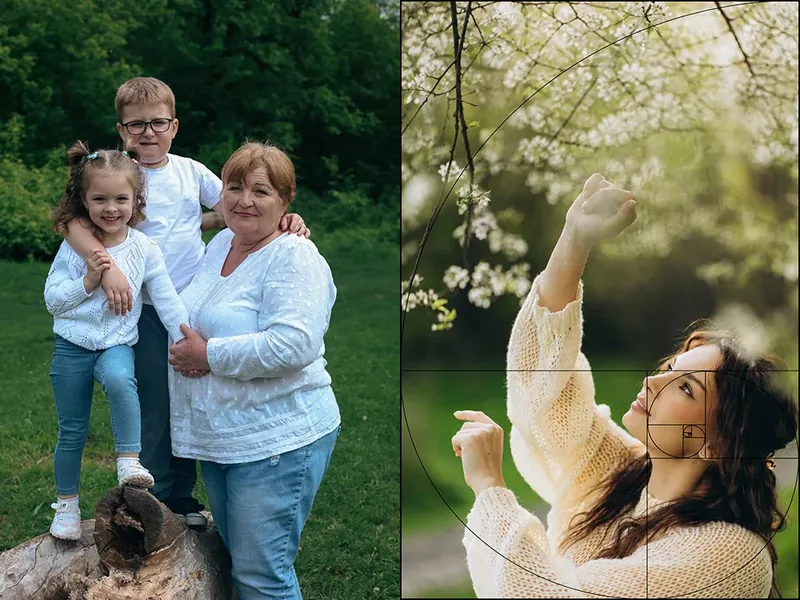 Yaroslava Vorona
I show the grids on real photos: the same phone, the same spot, the same second, and the pictures come out different. The masterclass comes with a trainer that overlays the grids right on your phone’s camera.
Watch the masterclassYour first portfolio: three series instead of a thousand photos
A portfolio brings in bookings like the work it shows, and that’s the main rule for building one. Shoot exactly what you want to be paid to shoot, or people will come to you with requests you’ll be tired of within the first month. A thousand different photos in a profile work worse than three finished series in one niche: a series shows the client that you hold your level through an entire shoot.
Friends, your own family, the neighborhood coffee shop on the corner, a small store near your home. Put a specific day on the calendar, ideally in daylight hours.
A wide shot, a medium shot, a detail and a few versions of the main shot. Always take extra frames, because in a portrait the eyes close at the best moment.
Weak photos hurt a series more than leaving them out. Post your five best and say in the caption what exactly you were shooting.
Three series in one niche read as a photographer’s work. One series reads as a lucky accident.
Shoots for a review, and the date after which it’s paid only
You need shoots for a review only for as long as you’re building a portfolio. After that they start working against you, because a circle forms around you of people who are used to getting your work for free. So set the end date for this period right away, before your first free shoot. I recommend aiming for three to five series or six weeks, whichever comes first. After that date you shoot only for money, even if your portfolio still doesn’t feel strong enough to you.
The terms of a shoot like this are agreed in advance, ideally in writing. The person you photograph gets the agreed number of photos, and you get the right to show them in your portfolio. Hand over part of the series, not every photo at once, because a free shoot with no limits almost always ends with “could I get just a few more?”
How long it takes to earn your first money
The timeline depends on how regularly you shoot, not on how many lessons you’ve watched. Olena Hordina got her first money for a shoot in the first weeks of the course, Viktoriia Usik after three months. The ones who move faster shoot every week and set up their shoots themselves.
| Period | What happens in that time |
|---|---|
| Month one | You’ve chosen a niche and shot your first series, and your profile shows what exactly you shoot |
| Months two and three | You’ve built three series, the people you know are aware of your niche, and the first inquiries have come in |
| Months four to six | Your profile shows a specific price, and your first paid shoots are happening |
Stability comes later than the first payment, and that’s a normal pace. In any niche, a photographer can fit in about ten shoots a month, because the rest of the days go to selecting photos, editing and messaging. That’s why income comes down to the price of one shoot, not the number of bookings. You can work out your own range by country, level and niche in the income calculator (free), and the full breakdown of rates by niche is in the article on making money in photography.
How to learn without spending two years on it
There are two ways to learn, and both work. Teaching yourself costs you only time. A school costs money and saves time. In a survey of our participants, 79 percent had never worked with a mentor, and that’s the most common reason the start stretches out for years. I still set aside one to two hundred dollars in my monthly budget for my own learning, even though I’ve been shooting for twenty years.
Whichever you choose, one rule holds: you have to shoot regularly. When I feel stuck, I make up a project for myself: ninety days of shooting every day. Rain, a bad mood and a lack of time have no say in this project, and that’s exactly why it gets me moving every time. It’s easier to keep that pace with ready-made themes, so I put together a thirty-day challenge: thirty shooting themes with prompts, at your own pace and not tied to specific dates.
Mistakes that drag out the start

While you save up for gear, months of practice simply don’t happen. Your first series gets shot on the phone that’s already in your pocket.
A profile where weddings, cakes and portraits are all mixed together doesn’t make sense to any client and keeps your price low.
Without a set deadline, free shoots go on for years, and the people you know gradually get used to not paying.
The people around you still don’t know about your niche, and that’s why they don’t reach out. One personal message works better than ten posts.
What to do this week
Take the one that pulls you the most and give yourself three months to test it.
Within the next seven days, a specific person, a specific place, in daylight hours.
Put a date on your calendar after which you work only for money.
A personal message to each one, in your own words, with one sample photo.
The lower end of your niche’s range in place of “let’s discuss” already changes the kind of people who message you.
The first week matters more than the next three months of thinking it over. A chosen niche and one finished series move you from asking “how do I become a photographer” to a completely different place: you’re already shooting and simply raising your level.
Composition grids change a photo with no new gear and no years of practice. A free fifteen-minute masterclass plus a trainer that overlays the grids right on your phone’s camera.
Watch the masterclassFrequently asked questions
How long does it take to become a photographer from scratch?
Can you become a photographer without a formal education?
How do you become a photographer in Ukraine if your city has few clients?
How much money do you need to start?
Can you take a paid booking if you shoot on a phone?
Real questions from the chat of my live sessions, word for word. I don’t name names.